Don’t Even Think About It: Why our Brains are Wired to Ignore Climate Change—a book review

George Marshall has written a book that is essential reading for everyone interested in communicating the science of climate change and its urgent policy implications. Don’t Even Think About It: Why Our Brains Are Wired to Ignore Climate Change comprises 43 short and well-written chapters that explain why  strenuous efforts to spread the word and spur action on climate change have failed.

There is no question that the problem is far from licked: the Keeling Curve continues its upward rise; American conservatives remain stuck in an intellectual dead end on climate; other countries pay lip service to the threat while making only token gestures to solve it; every year there is a big international get-together at COP meetings where thousands of delegates gather to push the policy boulder up Sisyphus’ hill, only to watch it roll down again. Opinion polls, it is true, show that there is broad public acceptance of the scientific basis of climate change, but the understanding of the problem is shallow. People say they care about climate change, but when it comes time to vote, other issues loom larger.

Marshall has worked for 25 years as a campaigner in environmental movements, including Greenpeace US and the Rainforest Foundation. He is a co-founder of the Climate Outreach Information Network, a UK based charity committed to ensuring that climate change and its impacts are understood and acted upon. Continue reading

Athabasca Glacier: a tragic vanishing act

Originally published at Skeptical Science on August 26, 2014

The Athabasca Glacier in the Canadian Rocky Mountains is probably the easiest glacier in the world to access by car. It’s just a few hundred metres’ stroll from the nearest parking lot on the magnificent Icefields Parkway in Alberta. The problem is, the stroll keeps getting longer by about 10 metres every year. Since 1992, the snout of the glacier has retreated about 200 metres, requiring tourists anxious to set foot on it to walk a little further. The glacier has lost about 2 km of its length since 1844 (Geovista PDF).

\The Athabasca Glacier seen from the access trail. This point is about halfway from the parking lot and the current snout of the glacier, which is about 200 metres away. In the centre background is the ice-fall from the Columbia Icefield.  The marker shows where the glacier snout was in 1992, coincidentally the year of the Rio Earth Summit. It is just possible to make out some people walking on the glacier on the left-hand side.Click for big.

Continue reading

Consensus, Criticism, Communication

Thanks in good part to our critics, our paper Quantifying the consensus on anthropogenic global warming in the scientific literature keeps getting more attention. It almost seems that you can’t open up a browser without seeing the “97%” meme somewhere. The extra interest prompted by Richard Tol’s recent critical article has maintained the rate of downloads of the paper at 500 per day and has pushed the total to nearly 200,000. The recent buzz has also spurred discussions on And Then There’s Physics, Variable Variability, Twitter, in The Guardian and a renewed line of criticism in a series of articles by Yale University Professor Dan Kahan.

I was surprised—a little shocked even—at some reactions to the release of our consensus paper. I was prepared, of course, for an angry response from those people who maintain that the expert consensus on the basics of anthropogenic climate change is either non-existent or crumbling. But my colleagues and I were never expecting to change their minds.

However, strong and sharply-worded opposition was unexpected from people like Dan Kahan (sarcasm), Mike Hulme (“infamous”), some journalists (“unwarranted attention”) and some climate scientists (satire), none of whom actually dispute the existence of an expert consensus on the basics of anthropogenic climate change. That the criticism often seemed tinged with peevishness (at least before they did some back-tracking) was especially surprising. I never saw our work as in any way undermining their approaches and analyses, but rather complementing them. And the complaints continue.

To give you a flavour of the nature of the recent discourse, here are some Tweets. (Keywords: Haha, doesn’t work, distraction, diversion, Sad, don’t inform, They insult, psychological control):

2014-06-21_18-24-49

The apparent anger and the throw-everything-at-the-wall criticism suggest that this is something other than a measured scholarly critique. Let’s first look at the main strands of argument in a bit more detail. Continue reading

Consensus Matters

The publication of the paper that I co-authored, Quantifying the consensus on anthropogenic global warming in the scientific literature,  in May 2013 caused quite a splash. The paper received a lot of positive coverage, including Tweets from Barack ObamaAl Gore and Elon Musk.  (They didn’t always get the details quite right: our survey was of the literature, not of scientists’ opinions and we had nothing to say about how dangerous climate change would be.) The paper has been downloaded, as of June 2nd 2014, 183,335 times, which is a record for any Institute of Physics paper. The editorial board of the journal, Environmental Research Letters, awarded the paper the “Best article of 2013” prize.  The research for the paper was done by a team of unpaid non-specialist volunteers of students and industrial and academic scientists, along with other enthusiasts and the funding for its publication was raised by donations from Skeptical Science readers. No taxpayers were harmed during the making of this article.

Image

Not everybody was pleased to see our work in print. In particular, many people who are unconvinced of the urgency to act on mitigating climate change have been claiming that our study is flawed and biased. Even somebody like economist Richard Tol—who accepts that global warming is real and caused by humans and who acknowledges that there is an overwhelming scientific consensus—has made extraordinary efforts over the past year to get a critique published. He finally succeeded, with the paper Quantifying the consensus on anthropogenic global warming in the literature: A re-analysis published in the journal Energy Policy,. The journal editors somehow came to believe that this article fell within its scope of  being “an international peer-reviewed journal addressing the policy implications of energy supply and use from their economic, social, planning and environmental aspects“.

Energy Policy was good enough to give us a chance to respond, which we did with this short paper, which has now (June 21, 2014) been  published. We were only allowed 1000 words, however, so we wrote a much longer article, published on the Skeptical Science website, detailing the 24 errors that Professor  Tol made. Continue reading

John Oliver asks: Are there hats?

On his new HBO show Last Week Tonight John Oliver skewered the whole idea that there is a genuine debate on the scientific basics of man-made climate change. He also mocked the conventional media format of  pitting one “skeptic” against one “scientist” that so badly misrepresents the real world of informed opinion.

I admit that I was particularly delighted to see the paper I co-authored with John Cook and other Skeptical Science colleagues get a mention.

Paul Krugman had a recent article in the New York Times where he looked at how some conservatives not only deny that humans are causing climate change, but also that they need to deny that expert opinion overwhelmingly believes that to be true, invoking an international conspiracy of scientists. And, in a blogpost he reminded us that conservative journalist Charles Krauthammer in “no Einstein”.

It’s tragic that there is no coherent conservative response to the problem of climate change. Any solution is going to require a policy consensus among people of all political persuasions.  The longer we put off a solution, the less likely it becomes that we will be able to deal with the problem with free-market measures. The more that conservatives rail against climate science on the bogus grounds that scientists want to usher in an authoritarian world, the more that dismal political future becomes likely.

Yet, as John Oliver shows us, tragedy and comedy are never far apart.

The Carbon Bubble – Unburnable Fossil Fuels – Seminar and Discussion

Originally published at Skeptical Science on March 26th, 2014

The British Columbia Sustainable Energy Association (BCSEA) organizes a series of free seminars on climate change and sustainability issues. BCSEA was founded by Guy Dauncey. On February 11th, 2014 BCSEA held a webinar on the recent work done by the Carbon Tracker Initative. Guy has written a detailed summary of their recent work on the BCSEA webpage.

The seminar starts at 8:30 minutes and a very good Q&A session begins at 39 minutes. The slides that accompany the seminar can be downloaded here.

The presenter is Mark Campanale, the founder and executive director of the Carbon Tracker Initiative. Continue reading

The Editor-in-Chief of Science Magazine is wrong to endorse Keystone XL

Originally published at Skeptical Science on March 3rd, 2014

An editorial by the Editor-in-Chief of Science Magazine, Marcia McNutt, conditionally endorses the Keystone XL (KXL) pipeline. Her argument is that:

  • the absence of the pipeline has not stopped oil sands development and the building of the pipeline will not accelerate oil sands development;
  • President Obama can extract concessions from the Canadians to reduce emissions and upgrade the bitumen in Canada.

Both of these arguments are wrong; let me explain why.

Pipelines promote production

The Mildred Lake oil-sands plant in Alberta. Note the tailings pond behind the huge yellow piles of sulphur, a by-product of bitumen upgrading. The sulphur may come in handy later for use in solar radiation management. Photo Wikipedia

Continue reading

Andrew Weaver’s support for a big bitumen refinery on the BC coast angers Greens

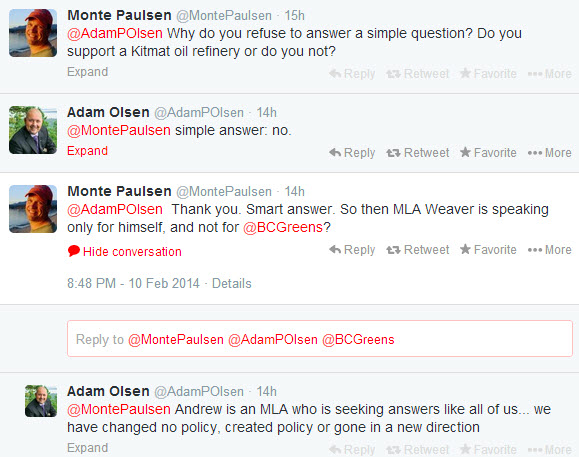
Andrew Weaver, the climate scientist turned Green Party politician, has raised hackles among environmental activists by lending support to a proposal to build a huge oil refinery near Kitimat in northwestern British Columbia. Despite the headlines, his support for it is qualified, seeing it as a compromise position that will keep diluted bitumen—dilbit—out of coastal waters, even if it doesn’t keep the carbon in the bitumen out of the atmosphere. Quoted in the Prince George Citizen, Weaver says:

“I like to think [of] the Green Party as a science-based, evidence-based common sense party,” he said. “It’s a party that realizes that we need gasoline in our cars but we also need to have a strategy to wean ourselves off that.”

and

“Rail is bad news, dilbit in the water is bad news, dilbit on land over rivers and streams is potentially very bad news,” he said. “Obviously as the Green Party [MLA], I’d prefer to keep it in the ground as much as possible and start to invest sooner than later into the low-carbon economy of tomorrow, but I’m pragmatic and I recognize at some point one may need to develop a compromise and a compromise solution is one that would actually give jobs in B.C.”

On Twitter, Adam Olsen, the leader of the BC Green Party, distanced himself and the party from Weaver’s position:

11-Feb-14 11-42-10 AM

Continue reading

Application to comment at the NEB Kinder Morgan enquiry

FrankejamesI have submitted an application to comment at a hearing of  the National Energy Board (Canada’s national energy regulator). The hearing  is about the proposal to greatly expand Kinder Morgan’s TransMountain pipeline, which runs from Alberta to Vancouver and will transport diluted bitumen to export markets in Asia. Once completed, the pipeline will carry more dilbit than either the better known Northern Gateway or the Keystone XL projects, some 890,000 barrels per day. In my opinion, the Northern Gateway project will probably get bogged down for years  in court challenges from aboriginal groups and  Kinder Morgan’s project is more likely to start construction first.

This was written on behalf of the Salt Spring Island Climate Action Council Society, of which I am the President. I have no illusions that this submission, which is just an application to be considered as a commenter, will be accepted. The terms of reference of the review panel have been narrowed to the extent that comments on the upstream and downstream environmental consequences of the project are deemed inadmissible. This is so arbitrary and obviously prejudicial that many people expect that the laws underlying these restrictions will be struck down by Canada’s courts. Challenges are already underway on the Northern Gateway review process. The NEB writes:

The Board does not intend to consider the environmental and socio-economic effects associated with upstream activities, the development of oil sands, or the downstream use of the oil transported by the pipeline.

As if the bitumen could be transported, without first being produced. As if the bitumen would be transported, if it were never to be consumed. It is like arguing that there’s no harm in falling off a cliff, just so long as you don’t hit the ground.

References, links  and more details can be found in my post Pipelines cause climate change, let’s talk about itHere’s what I wrote to the NEB.

Continue reading