The Exxon scandal: an industry insider’s view

I have no additional beans to spill about Exxon’s internal discussions on climate change, so if that is what you were looking for, I offer my apologies and advise you to read no further.

Nor will I spend much time rehashing the recent reports from Inside Climate News, the LA Times, the New York Times or the Guardian that recount what Exxon knew about climate change and what they did to promote doubt and delay climate policy in recent years . What I will offer is my perspective as an ex-oil industry insider on Exxon’s corporate culture and why their downplaying of their own in-house research is perhaps even worse than it appears. I’ll also look at how differently Exxon approached climate change compared to BP and Shell.

I have never worked for Exxon but, in my 30-plus years of oil industry experience, I have had a fair bit of exposure to Exxon’s culture through being involved with project partnerships with them, interactions with Exxon employees at technical conferences, and working with colleagues who had spent their formative years at Exxon. Most of my career was spent working for lesser-known, mid-size companies (Husky Oil, OMV, Encana) rather than the notorious Big Oil Companies. From the perspective of the smaller companies, the giant multinationals are seen as lumbering beasts, slow to act, slow to innovate, secretive and over-confident. Exxon was the biggest of the lumbering beasts, easy to run rings around in mature basins. As an example, consider how the big companies were bystanders and taken by surprise in the North American fracking revolution. Continue reading
2015 and 2016 global temperatures: a “what-if” exercise

It’s hardly news to predict that 2015 is almost certain to break the global surface temperature record.

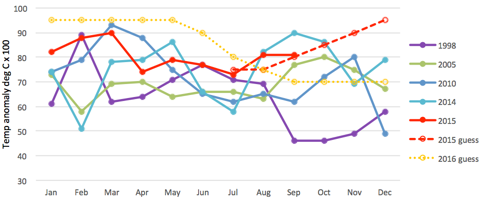
2015-10-12_12-24-30

The data in this graph are the latest NASA GISS monthly temperature anomalies (1951-1980 baseline), shown in solid lines, while the dashed and dotted lines are from the hitherto little-known future temperature series known as ANDY GUESS, updated in July 2015. I’m not attempting any serious forecasting here, just indulging in a what-if exercise. Note that my starting point in July is a little above the actual GISS value, for that month, this is because NASA subsequently tweaked their data a little. I have just selected a few recent hot years for comparison in this graph.

Basically, I have assumed that the current El Niño will persist until the end of the year, that its effects on global temperatures will lag by six months or so and that this El Niño will run a little hotter than recent ones. I just wanted to see how these guesses would play out for average global temperatures in 2015 and 2016.  The result is shown below.

Continue reading

B.C. lowballing fugitive methane emissions from natural gas industry

This was first published at Corporate Knights. I have added in this re-post some footnotes with details of calculations along with comments and references below the main article. I have also done a rough estimation of the emissions associated with the addition of one 18 million tonne per year LNG project (excluding end-use emissions) and the effect that this will have on BC’s emissions targets.


Photo by Jesús Rodríguez Fernández (creative commons)

The push by British Columbia to develop a new liquefied natural gas (LNG) export industry raises questions about the impact such activities would have on greenhouse gas emissions, both within the province and globally.

One of the single most important factors relates to the amount of methane and carbon dioxide that gets released into the atmosphere, either deliberately through venting or by accident as so-called fugitive emissions. Fugitive emissions are the result of valves and meters that release, by design, small quantities of gas. But they can also come from faulty equipment and from operators that fail to follow regulations.

According to the B.C. Greenhouse Gas Inventory Report 2012, there were 78,000 tonnes of fugitive methane emissions [1] from the oil and natural gas industry that year. B.C. produced 41 billion cubic metres of gas in 2012 [2]. This means about 0.28 per cent of the gas produced was released into the atmosphere [3].

By North American standards, this is a very low estimate. The U.S. Environmental Protection Agency (EPA) uses a figure of 1.5 per cent leakage [4], more than five times higher. Recent research led by the U.S. non-profit group, Environmental Defense Fund (EDF), shows that even the EPA estimates may be too low by a factor of 1.5 [5]. B.C.’s estimate, in other words, would be about one-eighth of what has been estimated for the American gas industry.
Continue reading

Carbon cycle feedbacks and the worst-case greenhouse gas pathway

Originally published at Skeptical Science on July 7, 2015

Summary

The worst-case emissions pathway, RCP8.5, is a scenario that burns a huge amount of fossil fuels, especially coal. The model has sometimes been criticized as implausible because of its huge resource consumption and emissions of ~1700 billion tonnes of carbon (GtC) over the century. Those emissions are based in part on carbon cyclemodel assumptions, which recent work suggests may be too optimistic. New research shows that future plant growth may be restricted by nutrient availability, turning the land carbon sink into a source. Also, permafrost feedbacks (not considered in IPCC CMIP5 models) may also add significant emissions to the atmosphere under the RCP8.5 pathway. In addition, the latest research on the Amazon Basin reveals that the tropical forest carbon sinks may already be diminishing there. Together, these feedbacks suggest that the greenhouse gas concentrations in the RCP8.5 case could be achieved with ~400 GtC smaller human emissions, making the RCP8.5 worst-case scenario more plausible.

The climate models referred to  in the recent IPCC Fifth Assessment Report (AR5) are founded on one of four Representative Concentration Pathways or RCPs. The key word in RCP is concentration. In the RCPs, the concentration of greenhouse gases is fixed at different times in the future and the climate model (or general circulation model or GCM) uses those atmospheric concentrations to calculate future climate states. Underpinning the concentration pathways are socio-economic and emissions scenarios. There can be more than one underlying emissions scenario capable of producing the concentration pathway.

If you are unfamiliar with RCPs, check out the great guide that Graham Wayne wrote in August 2013 for Skeptical Science.

This way of modelling differs from previous approaches in which the starting point was a story or scenario about economic and social development that led to emissions. These emissions are run through a carbon-cycle model (which may be simple or complex) to produce atmospheric concentrations over time.

The schematic illustrates the differences in approach. The elements in red boxes are the prescribed inputs into the models, whereas the elements in blue ellipses are outputs. The advantage of the RCP prescribed-concentration approach is that the climate model outputs do not depend to the same degree on carbon-cycle models as they did in the emissions scenario method. The disadvantage is that there is no unique link between concentrations and emissions. The schematic is simplified in that there are feedbacks and loops in the processes that are not illustrated. Continue reading

Are we overestimating our global carbon budget?

Research on carbon-cycle feedbacks suggests we have less wiggle room to turn the climate ship around.

(First published at Corporate Knights on July 7, 2015.)


Illustration by Yarek Waszul

The latest research suggests that natural sinks of carbon on land may be slowing or even turning into sources, creating climate consequences potentially worse than first thought.

Nature has provided humans with a buffer against the worst effects of our carbon pollution. Since 1750, we have emitted about 580 billion tonnes of carbon into the atmosphere by burning fossil fuels, cutting down forests and making cement. If those emissions had simply accumulated in the air, the concentration of carbon dioxide would have increased from 280 parts per million (ppm), as it was before the Industrial Revolution, to about 550 ppm today. Instead, we currently measure around 400 ppm, which is still a whopping 40 per cent above the planet’s pre-industrial atmosphere, but much less than a doubling.

Some 60 per cent of our emissions have been taken up in natural sinks by, in roughly equal parts, dissolving into the ocean and by being taken up by plants growing faster on land. Were it not for these natural carbon sinks, we would by now be much deeper into dangerous climate change.

As we continue to burn fossil fuels, our climate troubles will become worse should those sinks start to falter. And the outlook will be worse still if those sinks turn into sources of carbon.

Continue reading

Unsure about how to talk about uncertainty? Read this

2015-07-05_15-39-46Adam Corner, Stephan Lewandowsky, Mary Phillips, and Olga Roberts have today published The Uncertainty Handbook, which is a twenty-page practical guide for climate communicators. It is excellent, clearly written and I recommend that everyone read it all. Adam Corner has a blogpost outlining the Handbook at Shaping Tomorrow’s World.

As the authors say, everyone is already familiar with making decisions under uncertainty. To make plans means accepting that they may not unfold as expected. The natural world is chaotic, with many known-unknowns and unknown-unknowns. The human world is even more unpredictable. We all develop rules-of-thumb to deal with everyday uncertainty: whether to take an umbrella, when to take a vacation, whose advice to trust. But we humans do not always have good instincts when it comes to grasping the uncertainty of novel and unfamiliar situations. As Daniel Kahneman showed in his masterpiece Thinking, Fast and Slow we are often not very smart when confronting probability or logic problems in our lives, especially when they are expressed numerically.  The Economist reviewer wrote:

In one experiment described by Mr Kahneman, participants asked to imagine that they have been given £50 behave differently depending on whether they are then told they can “keep” £20 or must “lose” £30—though the outcomes are identical. He also shows that it is more threatening to say that a disease kills “1,286 in every 10,000 people”, than to say it kills “24.14% of the population”, even though the second mention is twice as deadly. Vivid language often overrides basic arithmetic.

Framing is everything.

Continue reading

You can now run a MOOC at your own pace, from July 1

The Denial 101x MOOC (Massive Open Online Course) was a great success, with thousands of participants and many satisfied students. I admit that I was quite touched by the mostly positive student reactions and I am thankful to John Cook for inviting me to contribute to this course in a small way. This video compilation of students’ feedback shows how people from diverse backgrounds all got something from the course.

From July 1, 2015 onwards, the course is available for anyone to follow at their own pace. It’s completely free of charge, naturally!

Continue reading

Why the 97 per cent consensus on climate change still gets challenged

Here are some excerpts from an article I wrote  for the magazine Corporate Knights, that was published on May 14, 2015. Some references and links have been added at the end. This is cross-posted with Skeptical Science.

In 2004, science historian Naomi Oreskes published a short paper in the journal Science concluding there was an overwhelming consensus in the scientific literature that global warming was caused by humans.

After the paper’s release, there was some unexpectedly hostile reaction. This prompted Oreskes and her colleague Erik Conway to go even deeper with their research, leading to the publication of the book Merchants of Doubt. It documents how a small group of scientists with links to industry were able to sow doubt about the scientific consensus and delay effective policy on DDT, tobacco, acid rain and, now, global warming.

Fast forward to two years ago: a team of volunteer researchers (myself included) associated with the website Skeptical Science decide to update and extend Oreskes’ research. Led by University of Queensland researcher John Cook, we analyzed the abstracts of about 12,000 scientific papers extracted from a large database of articles, using the search terms “global warming” and “global climate change.” The articles had been published over a 21-year period, from 1991 to 2011.

As an independent check on our results, we also sent emails to the more than 8,500 scientist authors of these articles. (These were the scientists whose e-mail addresses we were able to track down). We asked them to rate their own papers for endorsement or rejection of man-made global warming.

Both approaches yielded a very similar result: 97 per cent of the scientific literature that expresses an opinion on climate change endorses the expert consensus view that it is man-made. The results were published in May 2013 in the journal Environmental Research Letters.

We were astonished by the positive reception. Mention of the paper was tweeted by U.S. President Barack Obama, Al Gore and Elon Musk, among others. Obama later referenced it in a speech at the University of Queensland, while U.S. Secretary of State John Kerry has referred to the 97 per cent consensus in recent speeches. John Oliver based an episode of his HBO comedy show Last Week Tonight around it, a clip viewed online more than five million times.

Continue reading

Permafrost feedback update 2015: is it good or bad news?

This article was originally posted at Skeptical Science on April 20th, 2015

We have good reason to be concerned about the potential for nasty climate feedbacks from thawing permafrost in the Arctic. Consider:

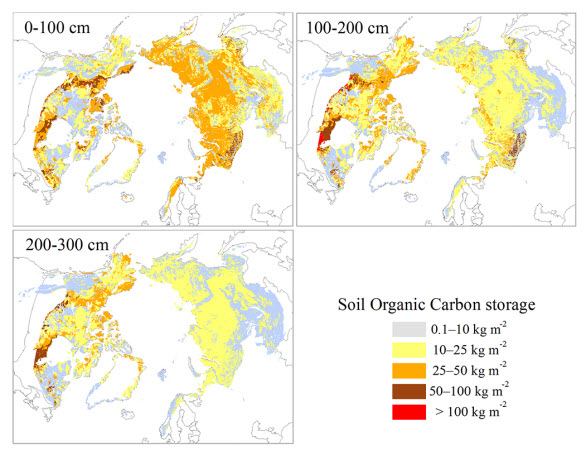
  • The Arctic contains huge stores of plant matter in its frozen soils. Over one-third of all the carbon stored in all of the soils of the Earth are found in this region, which hosts just 15% of the planet’s soil-covered area.
  • The Arctic is warming at twice the rate of the rest of the planet. The vegetable matter in the soils is being taken out of the northern freezer and placed on the global kitchen counter to decompose. Microbes will take full advantage of this exceptional dining opportunity and will convert part of these plant remains into carbon dioxide and methane.
  • These gases will add to the already enhanced greenhouse effect that caused the Arctic warming, providing a further boost to warming. There’s plenty of scope for these emissions to cause significant climatic mischief: the amount of carbon in the permafrost is double the amount currently in the air.

But exactly how bad will it be, and how quickly will it cause problems for us? Does the latest research bring good news or bad?

Ted Schuur and sixteen other permafrost experts have just published a review paper inNature: Climate change and the permafrost feedback (paywalled). This long and authoritative article (7 pages of text, plus 97 references) provides a state-of-the-art update on the expected response of permafrost thawing to man-made climate change. Much of the work reported on in this paper has been published since the 2013 IPCC AR5 report. It covers new observations of permafrost thickness and carbon content, along with laboratory experiments on permafrost decomposition and the results of several modelling exercises.

The overall conclusion is that, although the permafrost feedback is unlikely to cause abrupt climate change in the near future, the feedback is going to make climate change worse over the second half of this century and beyond. The emissions quantities are still uncertain, but the central estimate would be like adding an additional country with the unmitigated emissions the current size of the United States’ for at least the rest of the century. This will not cause a climate catastrophe by itself, but it will make preventing dangerous climate change that much more difficult. As if it wasn’t hard enough already.

Observations

There’s a lot of information in this paper and, rather than attempt to describe it all in long form, I’ll try to capture the main findings in bullet points.

  • The top three metres of permafrost contain about 1035 PgC (billion tonnes of carbon). This is similar to previous estimates, but is now supported by ten times as many observations below the top 1 m depth. Very roughly, the deepest deposits richest in carbon are near the Russian, Alaskan and Canadian Arctic coasts, with the poorest in mountainous regions and in areas close to glaciers and the Greenland ice sheet.

perm4The carbon content in the top three metres of permafrost soils. From Hugelius et al (2013).

Continue reading

Skeptical Science is running a MOOC

The volunteers at Skeptical Science, along with staff at the University of Queensland, have been busy over the past several months putting together a Massive Open Online Course (MOOC) on climate change. The course, Making Sense of Climate Science Denial, starts on April 28th and is free to anyone who wants to participate. It will last for seven weeks and will require an hour or two of attention every week.

The University of Queensland has a press release.

Thousands of people have already signed up, but we are hoping for many more. Learning will not just come from watching the many short video lectures we have prepared, but from discussions with fellow students. So, no matter what your level of knowledge, or  your point of view on man-made climate change might be, please join us. I’m looking forward to learning from this course, too.

All anyone needs is an Internet connection, a desire to learn and share your knowledge, and an ability to understand English spoken in American, British, Canadian and Australian accents.

Watch the trailer:

Continue reading

the urban prehistorian

the contemporary archaeology of prehistory

The Grumpy Geophysicist

A grumpy view of earth science and the world

A Progressive Rake

Funnies, rants, and quite a lot of gin

EssaysConcerning

Essays, musings & missives - concerning science, art & society

NixonScan

Culture & Natural Heritage

Stephen Leahy, International Environmental Journalist

Discovering Global Environmental Interconnections

The Mountain Mystery

Just 50 years ago, no one knew why the Earth has mountains. Now we do. This is the story of how we figured it out - and how we keep learning.

Understanding Climate Risk

Science, policy and decision-making

Small Epiphanies

A BLOG BY G.P. WAYNE

P.J. Partington

Thoughts on climate policy in Canada and around the world

@KenCaldeira

Environmental science of climate, carbon, and energy

The Practical Utopian

The World of Guy Dauncey

a minority of one

film reviews and related ramblings

Musings on Quantitative Palaeoecology

Once you have finished counting diatoms, the real fun begins

Kai Nagata

Writer / Videographer

HotWhopper

Reflections on the refractory problems of climate and energy

Real Skeptic

Ventures into skepticism

ClimateSight

Climate science from the inside

...and Then There's Physics

likhipa inhlanzi emanzini