

In a recent article in Skeptical Inquirer, geologist and writer James Lawrence Powell, claims that there is a 99.99% scientific consensus on Anthropogenic Global Warming (AGW). You might think that after all of the harsh criticism that the 2013 Cook et al. paper (C13) has received from climate contrarians that we would be pleased to embrace the results of a critique that claims we were far too conservative in assessing the consensus. While it certainly does make a nice change from the usual rants and overblown methodological nit-picks from the contrarians, Powell is wrong to claim such a very high degree of agreement.
He makes many of the same errors that contrarian critics make: ignoring the papers self-rated by the original authors; and making unwarranted assumptions about what the “no-position” abstracts and papers mean.
Powell’s methodology was to search the Web of Science to review abstracts from 2013 and 2014. He added the search term “climate change” to the terms “global climate change” and “global warming” that were used by C13. He examined 24,210 papers co-authored by 69,406 scientists and found only five papers written by four authors that explicitly reject AGW. Assuming the rest of the abstracts endorsed AGW, this gives consensus figures of 99.98% (by abstract) and 99.99% (by author).
His definition of explicit rejection would align roughly with the seventh level of endorsement used in C13: “Explicitly states that humans are causing less than half of global warming” . In the abstracts from 1991-2011, C13 found 9 out of 11,914 that fit level 7, which using Powell’s consensus calculation assumptions, would yield 99.92%. So, there is probably not much difference between the two approaches when it comes to identifying an outright rejection paper. It’s what you assume the other abstracts say—or do not say—that is the problem.
C13 also counted as “reject AGW” abstracts that: “Implies humans have had a minimal impact on global warming without saying so explicitly, e.g., proposing a natural mechanism is the main cause of global warming”. These are more numerous than the explicit rejections and include papers by scientists who consider that natural causes are more important than human causes in recent warming, but who do not outright reject some small human contribution.
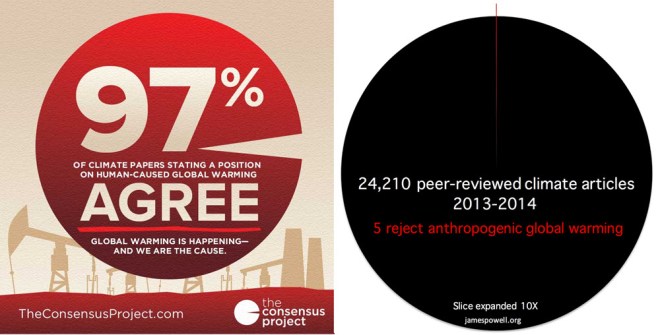
Competing Climate Consensus Pacmen. Cook on the left, Powell on the right.

 There is no question that the problem is far from licked: the Keeling Curve continues its upward rise; American conservatives remain stuck in an intellectual dead end on climate; other countries pay lip service to the threat while making only token gestures to solve it; every year there is a big international get-together at COP meetings where thousands of delegates gather to push the policy boulder up Sisyphus’ hill, only to watch it roll down again. Opinion polls, it is true, show that there is broad public acceptance of the scientific basis of climate change, but the understanding of the problem is shallow. People say they care about climate change, but when it comes time to vote, other issues loom larger.
 Critical Angle